
Peak Suburbia?
Riley Kane
8.14.2026
While we have not yet reached it, I expect to see peak suburbia within my lifetime.
On September 2, 1945, Japan surrendered to the United States, its cities destroyed by fire (and atomic) bombing. Hitler seemed prescient for having once said that Germany would be a world power or it would not be at all. Stalin ruled over Eastern Europe, but it was devastated from invasion, counter-invasion, and the deaths of between 20 and 27 million of his people. France, Belgium, and the Netherlands lay in ruins, first conquered, then fortified, then invaded and fought through during their liberation. Britain lay in physical and financial ruin, having traded its empire for survival.
However, the United States, protected by its Atlantic and Pacific moats, emerged from the war unscathed. America supplied the British and Soviets until it joined directly.
In 1945, America was the undisputed economic hegemon. The United States had already built an industrial base by supplying the British and Soviets before joining the war itself. Following the war, American investments and products rebuilt Europe and Japan, further enriching the United States. Simultaneously, wartime production and technologies were freed for civilian applications. And on top of all that, a baby boom was laying the foundations of the largest workforce and consumer base in American history.
America was likely destined to be a world economic power due to its size, resources, and position between Europe and Asia, but those already excellent traits were supercharged by the devastation of literally everyone else. And add to that the fact that those had never occurred in history. Between 1914 and 1945, all the great industrial powers twice waged a suicidal struggle for domination against each other (and America tactically sat out much of both). It seems impossible to replicate these conditions absent back-to-back Third and Fourth World Wars.
For many, the 1950s serve as an ideal to return to, and there is much to celebrate from those times. Americans were hopeful and saw a great future about to unfold. Vibrant American manufacturing meant that there were both plentiful, well-paying jobs (blue or white collar) and consumer goods were reasonably priced. Couples still got married and modern birth control was not widely available (and often still illegal), so there were many families with many children. And there was plentiful, cheap land in the new suburbs.
But those conditions were a direct result of America’s comparatively stellar experience during what the rest of the world experienced as an apocalyptic genocidal total war. For that reason, I refer to this period as the “Great Aberration.” Postwar America was a unique time caused by a confluence of great circumstances, resulting in an extreme deviation from historical norms.
Since 1945, America has had its ups and downs, but in 2026 we are still riding the wave of our success in WW2. However, that wave has been petering out for some time. Many factors have contributed to the sorry state in which we currently find our civilization (and I invite you to submit an article to us about one or more of them), but I want to focus on a defining feature of the Great Aberration—the Suburb.
And the entire history of what we know today as a “Suburb” is contained within the Great Aberration’s timespan. While the term may be drawn from the Ancient Roman suburbium, those were often just outside, or within a mile, of the City’s walls. A far cry from Milford, Florence, or Loveland.
The Levittowns, named after the company that built them, were the first modern suburbs. The very first was built between 1947 and 1951 in Nassau County, New York. The more famous Levittown, Pennsylvania, was built between 1952 and 1958.
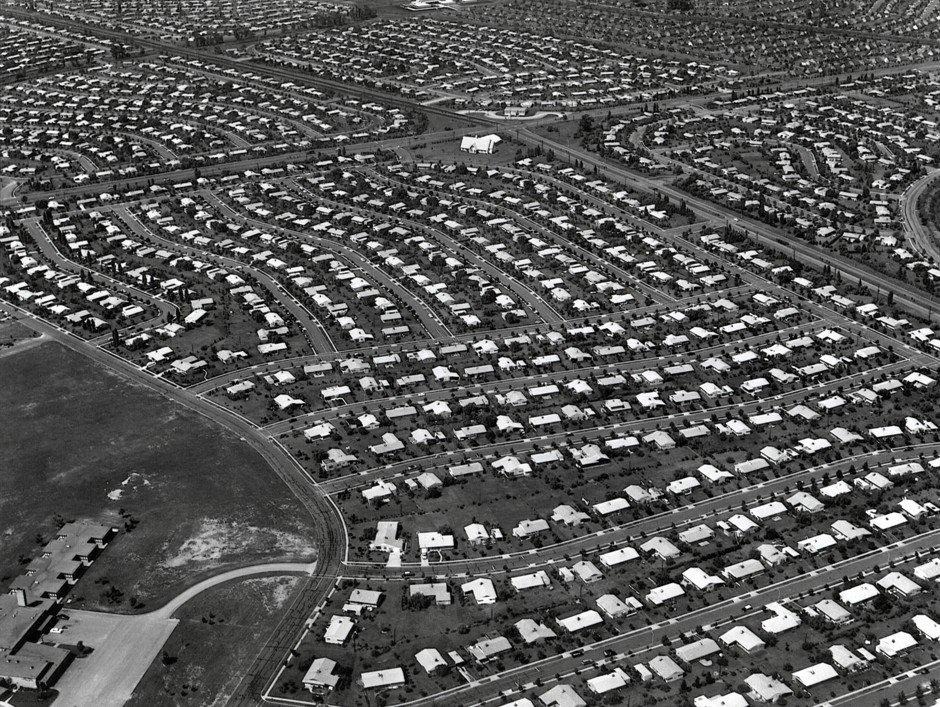
Levittown, PA (Wikipedia Commons).

The American Suburb was a triumph of modernity, the crowning achievement of advancements in industry, technology, and social coordination that had been underway for decades.
First and foremost, the suburb would not be possible without the automobile. In prior days, people could not live so far from work, family, shopping, or anything without some sacrifice—but the car let people have it all. An average adult can reasonably walk between 10 and 15 miles in a day. Madeira is over 11 miles from Cincinnati (Loveland, nearly 24). Without a car, many people’s daily communities would be stuff of science fiction. With the car, people were able to comfortably spread out.
And those cars had to be comparatively affordable as well. In the 1920s, motorcars were toys for the rich. But by the 1950s, wartime industrial capacity and innovation allowed cars to be produced in greater numbers and more cheaply, allowing them to become an essential part of American life.
Air conditioning also played an essential role in the rise of suburbia. Historically, homes needed to retain heat in Winter and resist, or expel, it in Summer. Techniques such as angling buildings to catch wind, high ceilings, layered brick insulation, transoms, and more were necessary for a home to be livable. All those features came at a cost. Brick layering was expensive, high ceilings added cost and wasted space, transoms complicated building, and designing homes in alignment with nature required bespoke personalization.
Initially, AC was so large and expensive that it was mainly used in factories to prevent manufacturing defects and overheating. However, the technology continually improved and, by the 1950s, air conditioning systems (with the help of that abundant postwar manufacturing capacity) could be produced affordably at a personal scale. Harnessing electricity for climate control let developers build more homes with simpler, standardized designs more quickly using cheaper materials, causing a boom in affordable, comfortable housing.
And those homes would be needed because the population was booming too. Initially, the original suburbs in places like Madeira, Blue Ash, or other nearer West Side were built up in the 1950s and 60s. Those communities continued to grow, but so did the suburban sprawl. Eventually, the term “exurb” was invented to describe suburbs that were far from a city, but still within its metropolitan orbit. Places like Florence or Mason once, respectively, had populations of 8,000 in 1958 and 5,000 in 1971. By 2020, Florence boasted a population of almost 32,000, compared with almost 38,000 residents in Mason.
The push for suburbanization continued throughout COVID, which seems to have prompted another housing boom as many fled more densely populated urban and inner suburban areas for the exurbs and near-country. That sprawl seems likely to continue. Some even speak about the future unification of the Cincinnati and Dayton metropolitan areas. Today, Cincinnati’s suburban (or exurban) frontiers stretch well into the surrounding counties and Northern Kentucky. I now know people living in parts of Ohio that I had once considered “out in the sticks” and people living in parts of Kentucky that I had never heard of before.
At this point, the suburb is quintessentially American. I expect everyone reading this has known of and interacted with suburbs for their entire lives. I grew up in one. My family drove up the highway to other suburbs to shop, go out for dinner, or visit the YMCA. In school, the marching band and sports teams drove to other suburbs to compete with their denizens. The city was comparatively foreign to me. I knew my dad worked there, and I sometimes went there myself to visit the Museum Center or see The Nutcracker with my grandma every few years.
I now live within the geographic bounds of my parish in the city, but I expect the experiences of my youth will be familiar to many. I cannot imagine a world without the suburbs. But such a world existed, and during the lifetimes of people who are still alive today. The suburb was born in 1947 from the same unique confluence of factors that caused the Great Aberration. But as those forces have continued to dissipate, especially over the past few years, I have been increasingly considering when and where we might find the natural limit of suburbia.
The forces that produced the suburbs have largely dissipated. The vast tracks of empty, easy-to-build-on land are now occupied by… suburbs. And those cheap buildings are getting old and expensive to maintain. For that matter, maintaining the vast networks of roads, sewers, and electrical grids connecting those homes is presenting a serious burden for suburban municipalities, which will likely need to raise taxes. At the same time, prices on electricity, water, gas, cars, groceries, housing, and everything else have been rising without a clear end in sight. And it is also no secret that fewer young people are getting married or starting families, to whom the major purported benefits of suburban living will matter little. And our population is poised to decline.
Yet the suburbs have continued expanding. And even if we import many millions of migrants to replace the boomers and the children people refuse to have, I don’t see how they’ll afford to live in homes that current working Americans cannot.
After COVID, I have become very skeptical of the so-called “conventional wisdom.” Even if the peddlers of conventional wisdom are not liars, I am concerned they are basing their assertions on outdated, partial, or inaccurate models, so their conclusions will be mistaken.
I am thinking of the garden-variety financial advisor who shows you a chart of the stock market from October 29, 1929 (just after the start of the Great Depression), to the present. He will implore you to invest everything there because, over time, the line always goes up. He might sincerely believe that. But he’s projecting the future based on the Great Aberration. It’s all he’s known, so you cannot blame him, but China had no serious manufacturing capacity to speak of until the 1990s, fuel and products were cheap, and Americans were building institutions rather than looting them.

I’m not in the city for economic reasons, but I’ve heard lots of people say that’s a big factor keeping them away. I’m in the city because of my parish. It is an added bonus that I also live within walking distance of many friends and my favorite attraction (Music Hall) and a relatively short driving distance to my family, most other friends, or pretty much anything around town. City living may not be for everyone, but there is a pernicious idea that suburban living ought to be the default. Nobody is born a default person, but some choose to become them.
A significant promise of suburban living is that your home will be an asset that will increase in value, but blindly trusting that claim is dangerous. Ownership carries responsibilities, and you’ll be left holding the bag if the investment (or neighborhood) goes bad. What if the line doesn’t go up because you bought at the top of the market? Or if the municipality hikes property taxes for long-deferred road and sewer repairs? Or if homes around you stop selling and remain vacant? If you’re only living there for money, that’s a disaster. But if you’re there because you like the lifestyle, or it’s near things you like, or near people you love, or near your God, then you might not make money, but will still have ready access to what’s important. Over the coming years, I expect specific suburbs will continue to prosper, while others will precipitously decline. A home is the typical American’s largest financial investment. You should think seriously about what you are investing in.