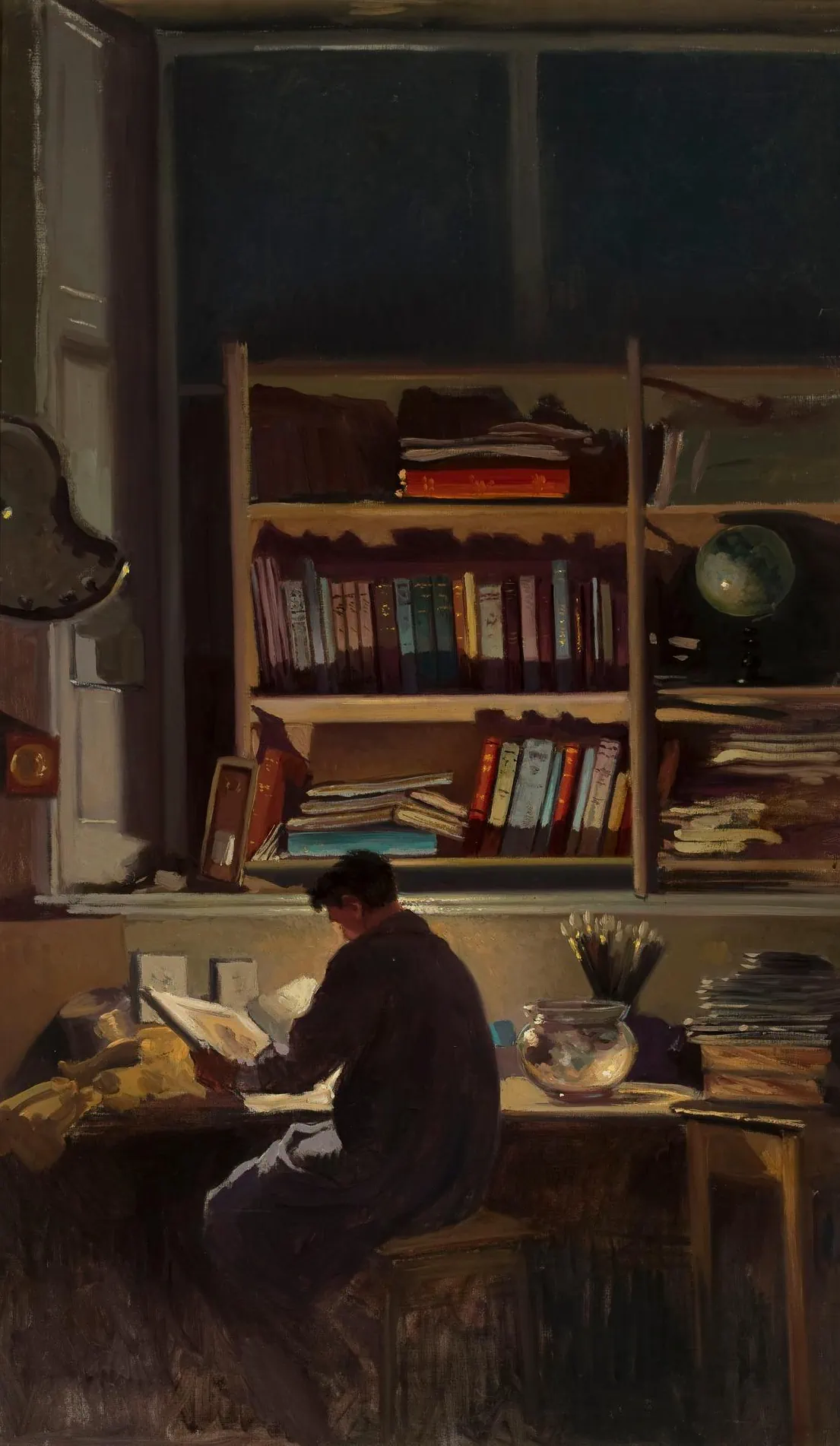
Spiritual Reading
Gabriel Connor
10.23.26
A priest once told me that he usually kept both a work of fiction and a spiritual
book for his daily reading. I have since adopted the practice, though it was no
serious adjustment; both genres are already what I mostly consume. It was only
the conscious thought of it, that I would keep a spiritual work as on a pilot flame
in the back pocket as I blazed through the Western canon, contemporary fiction,
backlogged recommendations, and all manner of literary digressions. A writer or
a reader is interested in the phenomenology of being, a writer or reader of faith is
also interested in the phenomenology of how one believes. The thought is that a
wisdom book and a work of fiction would read each other, even in accidental,
ridiculous and often surprising ways.
I run a bookshop called Anagoge Books, which presents fiction and poetry in
conversation with the writings of the saints and the theology and mysticism of
the Church. I chose the name “Anagoge,” the Greek word for climb or ascent, and
the fourth sense of meaning in scripture as defined by St. Jerome and other
Church Fathers: the text in relationship to the ultimate unfolding vision of reality:
past, present, future and especially, eternal. The theme of anagoge, or ascent, is
illustrated in the image of the mountain and the ladder, symbols of the journey of
the spiritual life. This is manifested in Scripture itself and all across the mystical
canon of the Church: the writings of John of the Cross, John Climacus,
Bernardino de Laredo, Gregory of Nyssa and of course is the particular and
stated arc of Dante’s Divine Comedy. Yet the ‘anagogic’ impulse of understanding
is not limited to words that are divinely inspired or even overtly concerning the
doctrines of the spiritual. Flannery O’Connor, in a letter to a fellow writer,
describes the anagogic dimension as “the kind of vision that is able to see
different levels of reality in one image or situation…which [has] to do with the
divine life and our participation in it…an attitude toward all of creation, and a way
of reading nature…” She explicitly suggests that the anagogical dimension, in her
particular art of writing fiction, is exactly where she seeks to raise her stories of
quotidian, grotesque reality, and where all great literature finds the stuff of its
brilliance.
We could then run away with this and say that all novel reading is “spiritual
reading,” as Dorothy Day once described her intake of Tolstoy and Dostoyevsky.
This is in a sense inescapably true, for reading even the most vile and disturbing
or just plain badly written book is a surefire way to locate a spiritual malady if one
seeks to. Spiritual reading in the tradition of the Church is a form of prayer
(lectio) and diverges from the practice of reading fiction in a number of ways, and
while lacking in the aesthetic concern, is much more consonant with the practice
of reading poetry. Spiritual books are not meant to be read with the iambic
cadence of ordinary speech and argument, but slowly and deliberately. You might
read an essay in an hour, a novel in a week, but the shelf life of a good spiritual
book might be several months. If you took the advice of The Cloud of Unknowing
literally, contemplating on one word of its seventy chapters per day, it would take
you seventy years to finish this slim 100 page book. Spiritual reading is one third
of monastic practice recommended to layfolk as a practice of prayer which
reminds, flutters and abases the soul with unscaled heights of perfection during
allowed intervals in their humdrum lives. In the oneiric, wakingly dream-lucid
practice of spiritual reading, the words supply and become one’s prayer through
an experience of mystagogia, where one is simply accepting and embracing all
things, however lofty, impossible or contradictory, and in this kind of suspension
of rationality and childlike faith it shares great relationship to poetry.
Unlike novels, spiritual books are not crafted narratives but often follow a rude
and naive construction. Like novels, spiritual books, once you’ve read enough of
them, do follow a pattern.
They always walk and guide the soul from the purgative to the illuminative
stages. As in The Imitation of Christ: exhortation in the voice of God, a dialogic
response in the soul addressing God, and interspersed with spontaneous
prayers. Narrative experiences are recorded, often in a byzantine design that
defies the sort of Fibonacci sequences one finds in the natural artwork of a novel.
Numbers are utilized, but their numerology or internal logic seldom makes any
sense. Julian of Norwich counts eighty six recorded visions, which are broken
down in labyrinthine exhortations: “and two things God told me to remember,”
“and then three things were revealed..,” “And from these I received nine
counsels..” Dionysius the Areopagite said that the rendering of visions so
harmonious must come off as necessarily askew to our sensory nature because
they are inexplicable by image or language. Art deals with the inexplicable (and
the askew) into a location of harmony.
Those who are wise in divine matters, and are interpreters of the mystical
revelations…prefer incongruous symbols for holy things, so that divine things
may not be easily accessible to the unworthy, nor may those who earnestly
contemplate the divine symbols dwell upon the forms themselves as the final
truth. We may celebrate the Divine Natures through the truest negations and also
by the images of the lowest things in contrast with their own Likeness….There is
no absurdity in portraying the Celestial Natures…by discordant and diverse
symbols: for possibly we ourselves might not have begun to search into the
Mysteries which lead us to the Heights through the careful examinations of the
holy Word, had not the ugliness of the imagery of the Angels startled us, not
suffering our mind to dwell upon the discordant figures, but stimulating it to leave
behind all material attachments, and training it by means of that which is
apparent to aspire devoutly to the supermundane ascent.
What funny irony then that fiction, which deals with all manner of sinful, fallen
reality, is deliberately wrought with beautiful craft, while the pure wisdom of God
presents itself recklessly unadorned and even sometimes intentionally
disfigured!
Looking at my reading history, I had Sayings of the Desert Fathers with Moby
Dick, The Recognitions with Revelations of Divine Love, The Imitation of Christ
with Anna Karenina. I can’t write a comparative book report of some of these
without stretching the definition of sanity. Could you make a connection between
Moby Dick and The Desert Fathers? I might make suggestions of temporalities: if
reading Proust, why not try The Spiritual Flora by St. Francis de Sales, to learn
what the precise relationship of the Hawthorn flower is to virtue? For every nature
writer like Thoreau, there is the ‘Centuries’ of Thomas Traherne which is a prose
hymn in 400 strophes in praise of creation. For those writers that eschew nature
and speak of the byzantine ambulations of the mortal mind, such as Henry
James, there is no shortage of mystics who shun natural goods and there is
Bellarmine’s Preparation for Death and a whole tradition of memento mori
literature from the seventeenth century, the age of the vanitas tableau.
Spiritual books range from the devotionally saccharine to the intensely
metaphysical. They are often deceptively titled after what reads like supra-
sensual counterparts to popular genres of past days: classical rhetorical
grammars, worldly wisdom compendiums, etiquette and comportment readers,
and mystery-fantasy adventure serializations. Story of a Soul, Interior Castle, Way
of Perfection, The Living Flame of Love, The Ascent of Mount Carmel, The
Spiritual Canticle, Introduction to a Devout Life, Abandonment to Divine
Providence, Uniformity to God’s Will, True Devotion to the Blessed Virgin and
Preparation for Total Consecration. There are obscure titles like The Flowing
Light of the Godhead, Book of Divine Works, Book of the Rewards of Life, The
Journey of the Mind Into God, Heliotropium: Conformity to the Divine Will, The
Aurora, The Signature of All Things, The Adornment of the Spiritual Marriage, The
Book of Truth & The Sparkling Stone, The Book of Privy Counsel, The Ladder of
Divine Love, Little Book of Eternal Wisdom, Mirror of the Soul…
I get these titles from an outdated archive website with a celestial name I like:
CCEL: Christian Classics Ethereal Library.
Spiritual books are often jealous of other spiritual books. A spiritual book tells
you not to put too much trust or stock in other spiritual books, and then usually
in itself as a disclaimer before you read it. It is always a comedy of censure and
self-erasure. I have a copy of a book which belonged to a Cistercian monastery
with scribbled note on the flyleaf: permission is required to read forbidden books.
What is the book in question? The Ladder of Humility by St. Bernard of Clairvaux.
The founder of their order.
And that is true, humility. The writer of a spiritual book was committing his words (whether yet executed or perfectly lived out) as an aspiration to himself as much as the reader ingests them as aspiration now. But so does the writer of fiction. Rilke in The Notebooks of Malte Laurids Brigge moves between the phantoms of memory and orisons of hope and maxims of a wisdom he aspired to live by. Ultimately the narrator ends the book in the confession of the prodigal son, however looking at the forwardly purgative path which had been dug out from an examination of his past. Rilke ends the novel with: “And he was not yet ready.” A lot of literature lives in tension with the spiritual life. In the spiritual life there are three conversions: purgative, illuminative, and unitive. Even the most ‘Catholic’ novels written by the most devout Catholics barely cross the rubicon of the all too human purgative phase, and in fact dwell in extremes of the fallen and distorted, which are perhaps analogous images of the Pseudo-Dionysian divine grotesques. There are few novels that approach the illuminative stage, which is
won through the passive purgation of the senses, or dark night of the soul. Off
the top of my head, the only one I can think of is The Diary of a Country Priest. St.
John of the Cross was a rigorous logician and a dark night of the soul is more
dusty and technical than makes exciting fiction outside convent walls. Can
anyone think of a novel written about life lived in the unitive way? It would cease
to be a novel and become a mystical treatise.
A writer is scrupulous and zealous for the phenomena of their interior life, and so
a writer of a religious character is going to be both jealous and zealous of the
interior life as experienced through the religious furnishings which accompany
their prayer or contemplation, and is necessarily docile to the shadows of
memory. But to a mystic this kind of sensory furniture is necessarily burned off:
one does not clutch at previous rhapsodies, one does not put trust in visions or
the phantoms of faith, nostalgia of any experience, even religious experience has
melted away in trained direction of a singular ascent. Jacques Maritain once said
“to have been written as it should have been written, the work of Proust would
have needed the inner light of an Augustine.” Proust might have lighted his
cathedrals with faith, but the saint within Augustine would have been careful not
to obsessively dwell in the liminality of memory which was the precise work of
Proust.
When we think of the “interior life” as it is invoked by theologians and mystics,
the term is interchangeable with the devotional life. I’ll confess, there is
something kind of frustratingly precious about this definition to me, as if all else
were exterior to us but an aptitude for theological instruction. Is any layman’s
interior life really a collection of incessant votive offerings? One could hope, but
probably not. One’s interior life is also crowded with a jumble of creative
imaginings, unidentifiable rumblings, intrusive thoughts, intellectual banter,
profound loves, sick jokes, deep solace in the written word, and all manner of unsorted desires. The interior life is at once vast and expansive and yet a strict
and singular plunge into the depth of one’s soul. Ultimately in the life of a
Christian it is a place of devotion, whether the all of it is yet to be consorted
together into a single prayer.
Because the spiritual life is necessarily dark and obscure, its phases and
trajectories often indiscernible, narrative literature grounds us in the enfleshed, in
the what are the trials and temporalities in nature as much as spirit, in interiorities
that are candidly expressed not from a place of negation: in sufferings, joys and
absurdities that are concrete.
A novel, well read and well wrought, will dramatically render a prelude to a
moment of grace and dispose us to contemplation of wisdom. Spiritual reading
divests us of dramatic action and allows us to soothingly (and achingly) glimpse
the drama of the soul, in ourselves and all manner of situations, fictive and real.
As much as one reads for God and His wisdom, stranger yet one is revealed the
thoughts of his own heart. All that is helplessly encrypted in the conversations of
fiction is unfurled in clarity, like the seven scrolls of Revelation, in the celestial
margins of a spiritual book.
As George Eliot said about The Imitation of Christ:
It is the chronicle of a solitary, hidden anguish, struggle, trust, and triumph, not
written on velvet cushions to teach endurance to those who are treading with
bleeding feet on the stones. And so it remains to all time a lasting record of
human needs and human consolations; the voice of a brother who, ages ago, felt
and suffered and renounced.
We need spiritual books to read the dreaded and familiar thoughts of man as
much as we need novels to bring us to a surprise illumination of God.
I’ll end with a word by Leon Bloy, 19th-century French mystic, madman and
literary pariah. Bloy wrote several novels, although Graham Greene said he
lacked “creative instinct,” instead busying himself in firebrand polemical tracts
that were one part evangelical, apologetic exhortations to Catholic tradition, part
cleverly invective blackmailing against his writerly nemeses. He was a
medievalist at heart, and believed as a faithful scholastic that every created thing
on earth was a symbol and a sacramental which prefigured a heavenly reality.
Jorge Luis Borges, in his essay “The Mirror of Enigmas,” says that Bloy took
anagogical method of scriptural study and applied it to the entirety of existence.
“Bloy postulates this hieroglyphical character — this character of a divine
writing, an angelic cryptography — at all moments and in all beings on earth.”
‘Every man is on earth to symbolize something he is ignorant of and to realize a
particle or a mountain of the invisible materials that will serve to build the City of
God…There is no human being on earth capable of declaring with certitude who
he is. No one knows what he has come into this world to do, what his acts
correspond to, his sentiments, his ideas, or what his real name is, his enduring
Name in the register of Light… History is an immense liturgical text where the
iotas and the dots are worth no less than the entire verses or chapters, but the
importance of one or the other is indeterminable and profoundly hidden.’